Energized statues on sale 70% off until May 29
order here
**Grandmaster
Put Strong Enerized Signal
in Sakayumani Buddha Gold Statue,
Will
Help You Get more spiritual &
Englightenment
Lights !
The energized statue will create a strong "Qi Field" in your house or office
|
The Great Enlightenment
After asceticism and concentrating on meditation and Anapana-sati (awareness of breathing in and out), Siddhartha is said to have discovered what Buddhists call the Middle Way—a path of moderation away from the extremes of self-indulgence and self-mortification. He accepted a little milk and rice pudding from a village girl named Sujata, who wrongly believed him to be the spirit that had granted her a wish, such was his emaciated appearance. Then, sitting under a pipal tree, now known as the Bodhi tree in Bodh Gaya, he vowed never to arise until he had found the Truth. Kaundinya and the other four companions, believing that he had abandoned his search and become undisciplined, left. After 49 days meditating, at the age of 35, he attained Enlightenment; according to some traditions, this occurred approximately in the fifth lunar month, and according to others in the twelfth. Gautama, from then on, was known as the Buddha or "Awakened One." Buddha is also sometimes translated as "The Enlightened One." Often, he is referred to in Buddhism as Shakyamuni Buddha or "The Awakened One of the Shakya Clan."
At this point, he realized complete awakening and insight into the nature and cause of human suffering which was ignorance, along with steps necessary to eliminate it. These truths were then categorized into the Four Nole Truths; the state of supreme liberation—possible for any being—was called Nirvana. He then came to possess the Nine Characteristics, which are said to belong to every Buddha.
- The Four Noble Truths: that suffering is an inherent part of existence; that the origin of suffering is ignorance and the main symptoms of that ignorance are attachment and craving; that attachment and craving can be ceased; and that following the Noble Eightfold Path will lead to the cessation of attachment and craving and therefore suffering.
- The Noble Eightfold Path: right understanding, right thought, right speech, right action, right livelihood, right effort, right mindfulness, and right concentration.
- Dependent origination: that any phenomenon 'exists' only because of the ‘existence’ of other phenomena in a complex web of cause and effect covering time past, present and future. Because all things are thus conditioned and transient (anicca), they have no real independent identity (anatta).
- Rejection of the infallibility of accepted scripture: Teachings should not be accepted unless they are borne out by our experience and are praised by the wise. See the Kalama Sutta for details.
- ): That all things are impermanent.
- ): That the perception of a constant "self" is an illusion.
- ): That all beings suffer from all situations due to unclear mind.
Sakyamuni) Siddhārtha Gautama a spiritual teacher from ancient India and the founder of Buddhism.[1] He is generally recognized by Buddhists as the Supreme Buddha of our age..
Siddhartha was born in Lumbini[1]and raised in the small kingdom or principality of Kapilvastu, both of which are in modern day Nepal. Culturally, these can be considered part of the broader region of Ancient India.[6] Gautama was the family name. His mother, Queen Maha Maya (Māyādevī) and Suddhodana's wife, was a Koliyan princess. As was the Shakya tradition, when his mother Queen Maya fell pregnant, she returned to her father's kingdom to give birth, but after leaving Kapilvastu, she gave birth along the way at Lumbini in a garden beneath a sal tree.
Siddhartha, destined to a luxurious life as a prince, had three palaces (for seasonal occupation) especially built for him. His father, King Śuddhodana, wishing for Siddhartha to be a great king, shielded his son from religious teachings or knowledge of human suffering. Siddhartha was brought up by his mother's younger sister, Maha Pajapati.[9]
As the boy reached the age of 16, his father arranged his marriage to Yaśodharā (Pāli: Yasodharā), a cousin of the same age. In time, she gave birth to a son, Rahula. Siddhartha spent 29 years as a Prince in Kapilavastu. Although his father ensured that Siddhartha was provided with everything he could want or need, Siddhartha felt that material wealth was not the ultimate goal of life.[10]
The Great Departure
At the age of 29, Siddhartha left his palace in order to meet his subjects. Despite his father's effort to remove the sick, aged and suffering from the public view, Siddhartha was said to have seen an old man. Disturbed by this, when told that all people would eventually grow old by his charioteer Channa, the prince went on further trips where he encountered, variously, aman, a decaying corpse, and an. Deeply depressed by these sights, he sought to overcome old age, illness, and death by living the life of an ascetic.
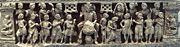

The Great Departure. Gandhara, 2nd century CE.
Siddhartha escaped his palace, accompanied by Channa aboard his horse Kanthaka, leaving behind this royal life to become a mendicant. It is said that, "the horse's hooves were muffled by the gods"to prevent guards from knowing the Bodhisatta's departure. This event is known as "The Great Departure".

|